LED Color Consistency: SDCM, ANSI Binning and Batch Matching
Color complaints tend to arrive at the worst moment. A linear run in a hotel lobby is switched on and one section looks faintly green next to its neighbours. A retail chain opens its fifth store with fixtures from a reorder, and the downlights look pinker than in stores one to four. A contractor fits three spares in an office, and they stand out from across the room.
Every one of these fixtures was sold as “3000K”, and none is defective in the narrow sense. A nominal correlated color temperature (CCT) describes a region on the chromaticity diagram, not a single point. The width of that region, plus what happens inside the luminaire and over its life, decides whether fittings mounted side by side actually match.
This article explains SDCM, ANSI C78.377 quadrangles, color drift over time, and purchase terms that keep repeat orders consistent.
Information in this article is current as of 7 October 2026. Standard and regulation editions are cited explicitly; verify against the current edition before writing a specification.
1. Why Fixtures With the Same CCT Look Different
CCT compresses a two-dimensional color position into one number. Two sources can share a CCT and still sit at different points on the chromaticity diagram:
- Position within the CCT range. A nominal “3000K” region spans a range of CCTs. Fittings at its warm and cool edges are both legitimately 3000K.
- Duv: green versus pink. Duv is the distance above or below the Planckian (blackbody) locus. Sources above it look slightly greenish; sources below it look slightly pinkish. Equal CCT with opposite Duv is often the most visible mismatch on a white wall.
- LED level versus luminaire level. Datasheet chromaticity is usually measured on the bare LED package, often at 25°C. In a luminaire the LEDs run hotter, at a different current, behind diffusers, lenses and reflector coatings that each alter the spectrum slightly.
- Dimming and tunable white. Chromaticity moves with drive current. Tunable-white products mix warm and cool channels, so consistency at 2700K and 6500K does not prove consistency at 4000K.
- Ageing. Phosphor and package materials change over thousands of hours. A new replacement will rarely match a fitting that has run for three years.
For a buyer, “3000K” on a quotation is a category, not a color specification.
2. SDCM and MacAdam Steps in Plain Terms
In the 1940s, David MacAdam measured how far apart two colors must be before observers can tell them apart. The zones of indistinguishable color around a centre point form ellipses — MacAdam ellipses — on the chromaticity diagram.
One “step” is one standard deviation of color matching; a 3-step ellipse is three times the size of the 1-step ellipse around the same centre. SDCM (standard deviation of color matching) is used interchangeably: “3 SDCM” and “3-step MacAdam” mean the same thing. Larger steps mean more visible difference.
Commonly cited industry practice — a rule of thumb, not a standard:
| SDCM / MacAdam steps | Typical perception | Typical application fit |
|---|---|---|
| 1-step | Essentially indistinguishable | Reference and specialist display work |
| 2-step | Very hard to see, even side by side | Continuous linear and cove runs, galleries, premium retail displays |
| 3-step | Rarely noticed side by side | Offices, hospitality and retail with adjacent fittings |
| 5-step | Visible in critical installations | Back-of-house, storage, warehouses |
| 7-step | Clearly visible when fittings are adjacent | Treat only as a floor (the ANSI quadrangle size) |
An SDCM value only means something together with the centre point it is measured from. And the eye is most critical when fittings are adjacent and light the same uniform surface: a continuous linear run grazing a white wall is far more demanding than downlights three metres apart over carpet.
3. What the Standards Actually Require
ANSI C78.377: quadrangles, not ellipses
ANSI C78.377 (current edition ANSI/NEMA C78.377-2024, replacing the 2017 edition) defines chromaticity quadrangles for nominal CCTs of 2700K, 3000K, 3500K, 4000K, 4500K, 5000K, 5700K and 6500K, plus extended 2200K and 2500K and flexible CCTs. The 2024 revision added nominal 1800K and 2000K for outdoor and special indoor applications. It also sets a Duv tolerance around the Planckian locus.
The basic quadrangles are 7-step quadrangles: four-sided zones roughly comparable in extent to 7-step MacAdam ellipses, though the match varies with CCT, and designed to be continuous without gaps. Smaller 4-step quadrangles are also defined.
The so-what: two products can both be “ANSI 3000K”, inside the same 7-step quadrangle, yet sit at opposite corners and look visibly different. ANSI compliance tells you which nominal CCT a product belongs to; it is not a tight SDCM claim.
EU Regulation 2019/2020: six steps, per light source
Commission Regulation (EU) 2019/2020, Annex II, requires LED and OLED light sources to show color consistency within a six-step MacAdam ellipse or less. Color consistency is defined as the maximum deviation of the initial chromaticity coordinates of a single light source from the centre point (cx, cy) declared by the manufacturer or importer.
Each light source is measured against its own declared centre point. The rule does not require two batches, or two products with different declared centre points, to match each other, and it says nothing about color after hours of operation.
DLC technical requirements V6.0
The DesignLights Consortium (DLC) released Technical Requirements for LED Lighting SSL V6.0 and LUNA V2.0 on 3 November 2025, superseding V5.1:
- DLC Standard: chromaticity within at least one basic, flexible or extended nominal 7-step quadrangle per ANSI C78.377-2024 (indoor 1800–6500K; most outdoor and high-bay 2200–5000K; sports lighting and fuel pump canopy up to 5700K).
- DLC Premium: indoor products except high-bay within a 4-step quadrangle, 2200–6500K.
A 4-step quadrangle is a real improvement, but it is still a zone around nominal CCT, not a promise that two specific products match within 2 or 3 steps.
4. How LEDs Are Measured and Binned
LED package suppliers measure every device and sort it into chromaticity bins (small x,y regions), luminous flux bins and forward-voltage bins. A commonly quoted chromaticity bin tolerance is about ±0.003 in x and y — typical practice, not a standard figure.
Luminaire makers reach a tighter SDCM in one of two ways:
- Narrow binning (micro-binning). Buying from a single tight bin. Direct control, but higher cost, longer lead times and supply risk when that exact bin is unavailable for a reorder.
- Bin mixing (blending). Combining complementary bins on one board so the mixed light lands near the target. More supply-efficient, but it depends on a disciplined mixing rule and good optical blending.
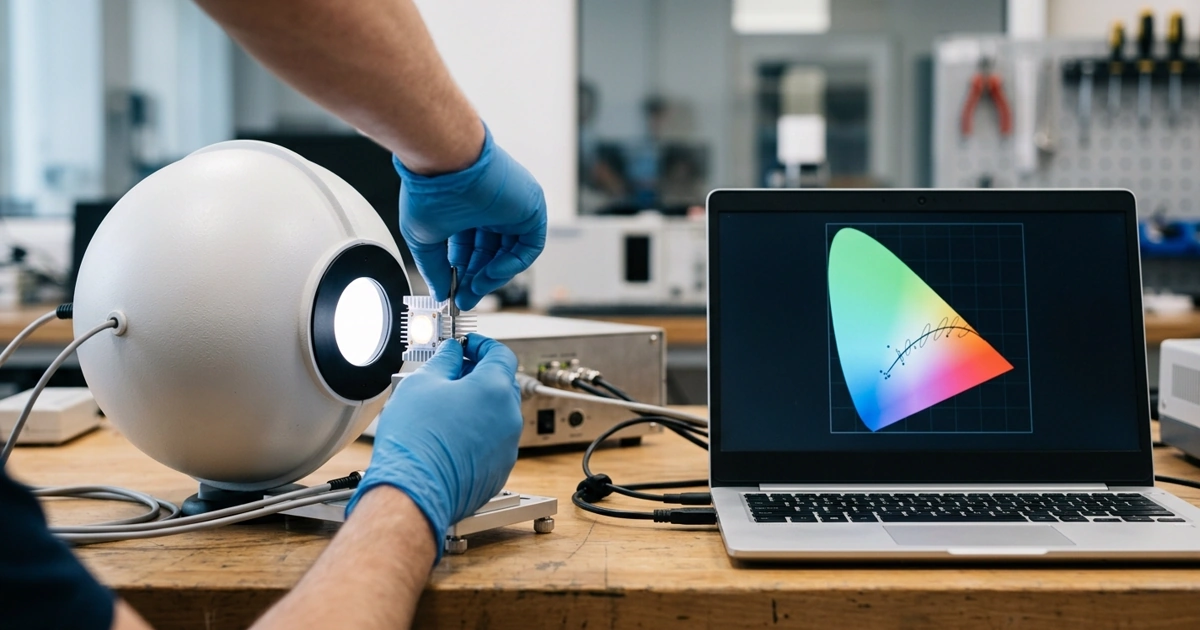
Neither method guarantees the luminaire result. Optics, higher operating temperature and actual drive current all move the color, so LED-level SDCM is not luminaire-level SDCM. The finished fitting should be measured as a complete product — integrating sphere or goniophotometer, per IES LM-79 — after reaching thermal steady state.
5. Color Shift Over Time: Δu’v'
LED chromaticity drifts with operating hours. The drift is expressed as Δu’v’, the distance moved on the CIE 1976 u’v’ diagram.
- ENERGY STAR (US EPA) luminaire specifications historically required Δu’v’ ≤ 0.007 through 6,000 hours. EPA sunset the lamps and luminaires specifications effective 31 December 2024, so 0.007 now survives mainly as a reference value used by DLC and in specifications.
- DLC V6.0 requires indoor products (except high-bay and non-white light) to keep chromaticity shift from about 1,000 h to about 6,000 h within Δu’v’ ≤ 0.004; outdoor, high-bay and E26/E39 lamps within ≤ 0.007. Evidence comes from ANSI/IES LM-80 and/or IES LM-84 data, with optional CS4 and CS7 reporting.
ANSI/IES TM-35-19 projects chromaticity shift from LM-80 data. It defines CS4 (hours until Δu’v’ reaches 0.004) and CS7 (hours until 0.007), and is not to be used with fewer than 10 units.
A U.S. Department of Energy study of 223 LM-80 data sets (RTI International and LED Lighting Advisors, March 2020) adds context. TM-35-19 describes three phases — incubation, recovery and emergence — and only emergence typically reaches the 0.004 or 0.007 thresholds. Projections were reasonable and often conservative for magnitude, but the direction of shift is harder to predict. Shift depends on temperature and drive current, so a hot-running fitting will usually drift faster than package data suggests.
The so-what: SDCM is a day-one snapshot. If fittings will be replaced or extended over a 10-year life, Δu’v’ maintenance data matters as much as the initial bin.
6. Keeping Multi-Batch and Reorder Shipments Matching
Most mismatch disputes on repeat business come from batches. Each batch may draw on a different LED lot and a different bin within the same quadrangle — all within datasheet claims. The controls belong in the purchase order:
- Record the declared centre point (cx, cy) and Duv on the PO, not only nominal CCT.
- Record the LED bin codes of the approved sample and first lot, and require the same bin family, or the same mixing rule, in later phases.
- Keep golden samples. Retain two or three approved, labelled fittings as the physical reference for every later delivery.
- Order spares from the same batch as the installation, sized for failures and planned extensions.
- Require notification of any change to the LED source, phosphor, optic or driver. A new LED package is a color change even when the datasheet CCT is unchanged.
- Phase deliberately. Keep adjacent zones in one batch and let batch boundaries fall where fittings are physically separated.
Incoming inspection and side-by-side verification
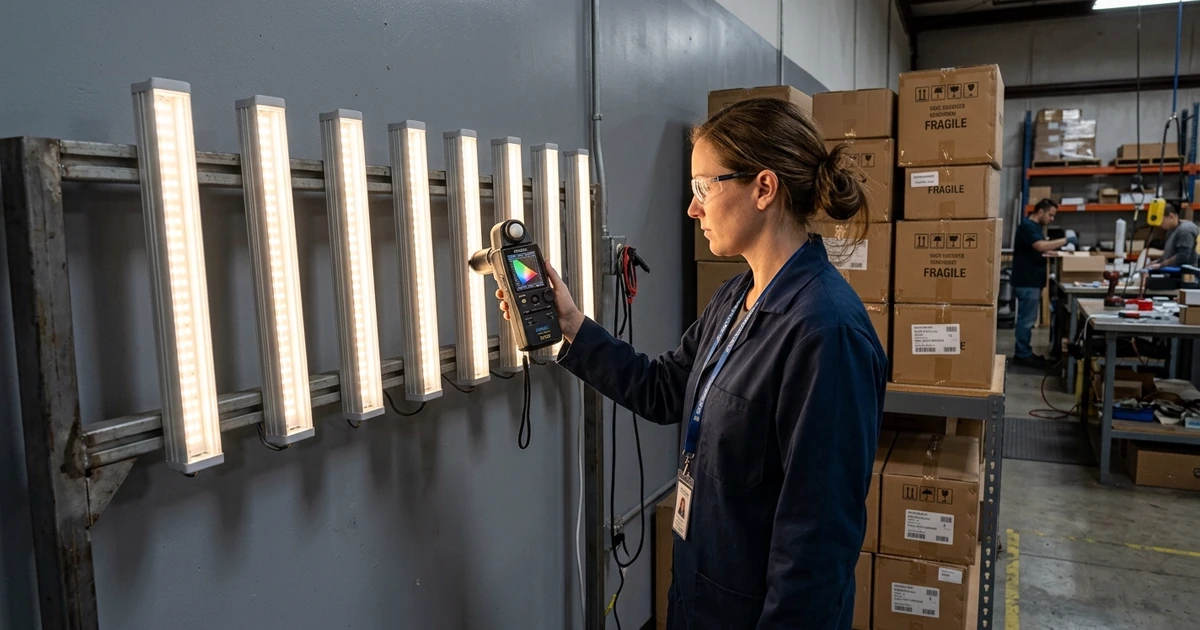
- Power a sample from each batch beside a golden sample until thermally stable, typically 30 minutes or more.
- Measure chromaticity, CCT and Duv with a calibrated handheld spectrometer at a fixed distance and angle.
- Compare readings with the declared centre point and between batches, and view the fittings side by side on a uniform white surface.
- For tunable-white or dimmable products, repeat at the warmest, coolest and a mid setting, and at the lowest dimmed level used on site.
A handheld meter is less precise than an integrating sphere, but it reliably catches the common failure: a later batch shifted a few steps towards green or pink.
7. Common Misconceptions
“3-step MacAdam” describes the luminaire. Usually it describes the LED package, measured at 25°C. Unless the claim states luminaire level at operating temperature, assume it excludes optics, heat and drive current.
“ANSI compliant” means consistent. It means each product falls within a 7-step quadrangle, or 4-step if stated. Products at opposite edges can look clearly different.
SDCM covers color over life. It describes initial spread only. Color maintenance is a separate Δu’v’ requirement backed by LM-80 and TM-35 data.
The same part number guarantees the same color. Part numbers usually persist across lots. Without a declared centre point, bin control and change notification, a reorder can be in specification and still not match the first order.
8. Specification Checklist
- SDCM at luminaire level, at thermal steady state and rated drive current — not package level at 25°C.
- Declared centre point (cx, cy) and Duv tolerance, with the ANSI C78.377-2024 quadrangle (7-step or 4-step) as a floor.
- Measurement method: IES LM-79, integrating sphere or goniophotometer, with laboratory and sample count identified.
- Color maintenance: a Δu’v’ limit (for example ≤ 0.004 indoors, aligned with DLC V6.0), supported by LM-80 data and TM-35-19 projections, with CS4 and CS7 where available.
- Tunable white and dimming: consistency at minimum, maximum and an intermediate CCT, and at the lowest dimmed level used.
- Batch control: bin codes on record, same bin family or mixing rule across phases, golden samples, change notification.
- Incoming inspection: handheld spectrometer checks on a defined sample per batch, with acceptance criteria agreed before shipment.
- Regional rules: the EU six-step limit; for California residential high-efficacy sources, Title 24 JA8 (2025) also requires CCT ≤ 4000K, CRI ≥ 90 and R9 ≥ 50.
9. FAQ: Common Questions on LED Color Consistency
Is 3-step good enough, or should we specify 2-step? For most offices and hospitality spaces, 3-step at luminaire level is a practical target. Specify 2-step where fittings form a continuous line of light or wash the same uniform surface — coves, linear runs, display walls. Tighter steps usually mean narrower binning, higher cost and longer lead times, so apply them by zone.
Does EU compliance mean our reorder will match the original? No. The six-step requirement compares each light source with its own declared centre point at initial operation. A reorder with a different declared centre point can still comply.
Can mismatched fittings already installed be corrected? Sometimes. Moving outliers to separated positions often hides a small mismatch, and replaceable LED modules can be swapped for matching ones. Where the shift comes from ageing, replacing a whole visible group is often the only reliable fix.
Conclusion
Color consistency depends on three separate things: how tightly the LEDs are binned around a declared point, what the luminaire does to that point through heat, current and optics, and how far the color drifts over life. ANSI C78.377 quadrangles classify nominal CCT, EU Regulation 2019/2020 limits initial deviation per light source to six steps, and DLC V6.0 adds 4-step quadrangles for Premium indoor products and Δu’v’ limits of 0.004 or 0.007. None of them, on its own, makes two batches match.
The practical change is to specify color at luminaire level, record the centre point and bin codes, require maintenance data, and verify each batch against a retained golden sample before installation.
Sources
- ANSI/NEMA C78.377-2024, American National Standard for Electric Lamps — Specifications for the Chromaticity of Solid-State Lighting (SSL) Products (7-step and 4-step quadrangles; nominal 1800K and 2000K added; supersedes the 2017 edition)
- Commission Regulation (EU) 2019/2020 of 1 October 2019 (EUR-Lex CELEX 32019R2020), ecodesign requirements for light sources and separate control gears, Annex II functional requirements (color consistency within a six-step MacAdam ellipse or less) and definition of “colour consistency”
- DesignLights Consortium, Technical Requirements for LED Lighting, SSL V6.0 and LUNA V2.0, released 3 November 2025 (supersedes V5.1)
- ANSI/IES TM-35-19, Projecting Long-Term Chromaticity Shift of LED Packages (CS4 and CS7)
- U.S. Department of Energy, Lumen and Chromaticity Maintenance Behavior of LED Packages Based on LM-80 Data, RTI International and LED Lighting Advisors, March 2020
- U.S. EPA, ENERGY STAR Program Requirements for Luminaires (Δu’v’ ≤ 0.007 through 6,000 hours), sunset effective 31 December 2024
- California Energy Commission, 2025 Building Energy Efficiency Standards (Title 24, Part 6), Reference Appendix JA8
Next scheduled review: April 2027, or earlier if ANSI C78.377 or the DLC technical requirements are revised.